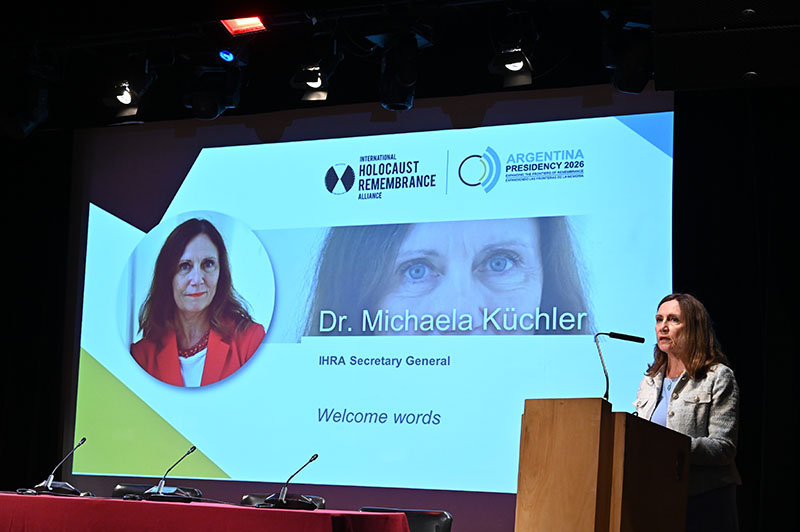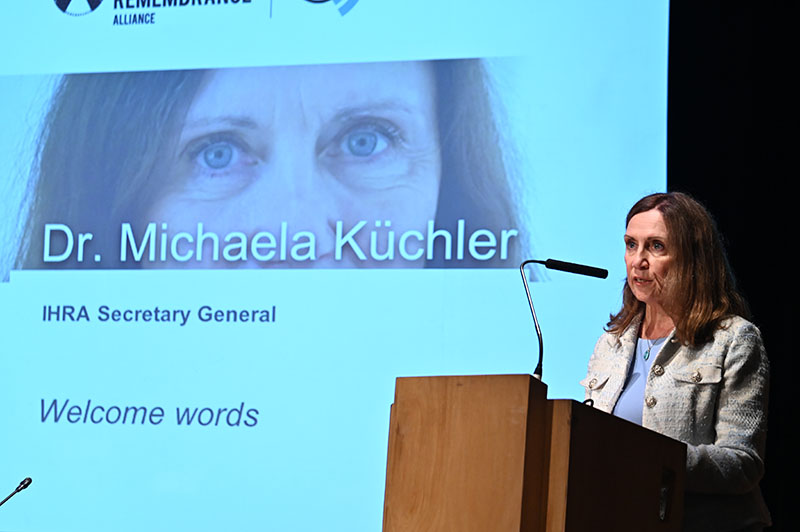
Good morning,
Excelencias, distinguidos invitados, colegas y amigos.
Excellencies, distinguished guests, colleagues and friends,
I am very pleased to take part in this conference organized by the Argentine Presidency.
IHRA today brings together 35 Member Countries. Yet the non-legally binding Working Definition of Antisemitism has reached well beyond IHRA itself – with 46 countries having adopted or endorsed it over the past decade.
This engagement reflects something important: the need for practical tools that help institutions recognize and respond to antisemitism in contemporary society.
Since its early years, IHRA’s working definitions have been important and well-recognized instruments for member countries and beyond. To date, the IHRA has issued three working definitions: the Working Definition of Holocaust Denial and Distortion, the Working definition of antisemitism, and the Working definition of antigypsyism/anti-Roma discrimination.
This year marks ten years since the adoption of the Working Definition of Antisemitism. Over the past decade, it has become an important international reference point in efforts to understand and address antisemitism.
At the same time, the persistence and evolution of antisemitism remind us why this work remains necessary. Jewish communities face threats, harassment, and violence in an unprecedented way. More dramatically, antisemitic rhetoric has become normalized online and in public discourse.
Antisemitism changes over time. Democratic societies must be able to recognize its contemporary forms.
This is why this Working Definition was developed. It was created as a practical, non-legally binding tool to help governments, institutions, educators, and civil society better identify and understand antisemitism. It provides a shared language that supports consistency, clarity, and informed responses.
The definition does not replace democratic debate or freedom of expression. It is intended to support understanding and practical assessment, while helping institutions and individuals identify when antisemitism may be present.
A definition alone does not solve antisemitism. But without clarity, effective action becomes much harder.
The real significance of the Working Definition lies not only in endorsement, but in implementation.
That is why it’s significant that today’s discussions focus on practice and real-world applications. As Secretary General of the IHRA, I also see my role as safeguarding the integrity and purpose of the Working Definition. Let me therefore underline a central point: the Definition is non-legally binding. This is not a weakness of the Definition – it is one of the reasons for its broad international acceptance and practical success.
Its strength lies precisely in this role: supporting institutions, including legal professionals and law enforcement, in recognizing antisemitism without becoming legislation itself.
Argentina has played an important role in demonstrating how the Working Definition can be applied across different sectors of society. The panels today reflect this clearly: in courts and legal institutions, in universities, in civil society, in sports organizations, and in interfaith dialogue.
This practical approach – developing tools that help institutions recognize and respond to contemporary challenges – remains central to IHRA’s broader work.
Over the past decade, we have seen growing engagement with the Working Definition of Antisemitism across Latin America and around the world. But our continued progress will depend on cooperation and on the willingness to exchange experiences, good practices, and lessons learned.
Governments cannot do this work alone. Neither can Jewish communities alone. Addressing antisemitism requires engagement from educators, legal experts, civil society, faith leaders, media professionals, sports clubs, and many others.
I hope today’s conference contributes to exactly this kind of practical and constructive exchange.
Ten years after the adoption of the non-legally binding IHRA Working Definition, our responsibility remains: to ensure that antisemitism can be recognized, understood, and addressed wherever it appears.
Thank you.