“By then we already knew about Auschwitz. They sealed off a neighborhood and rounded everyone up. My father happened to be out delivering bread. They pulled him off the street. Through a small hole in a wooden wall, I saw him for the last time in my life.”
This is how Holocaust survivor Gitla Klajman later described the last time she saw her father.
Distinguished Chair, dear colleagues, dear friends,
Many survivors, like Gitla, who rebuilt their lives in Argentina carried memories like these with them. Another of them was Eugenia Unger. After surviving the Warsaw Ghetto, Majdanek, Auschwitz and the death marches, she rebuilt her life here in this city.
Years later, she helped found the Holocaust Museum of Buenos Aires, that many of us will visit together later today. Survivors carried these memories across countries and across generations. Many of them helped build the museums, memorials, and archives that continue this work today.
And as the generation of survivors grows smaller, these institutions carry an even greater responsibility. Over the past year, the Israeli Presidency reminded us that we stand at a true Crossroads of Generations. We are moving from an era shaped by living testimony to one in which museums, memorials, archives and research institutions play an even greater role.
Because remembrance does not preserve itself. It must be researched, recorded and passed forward.
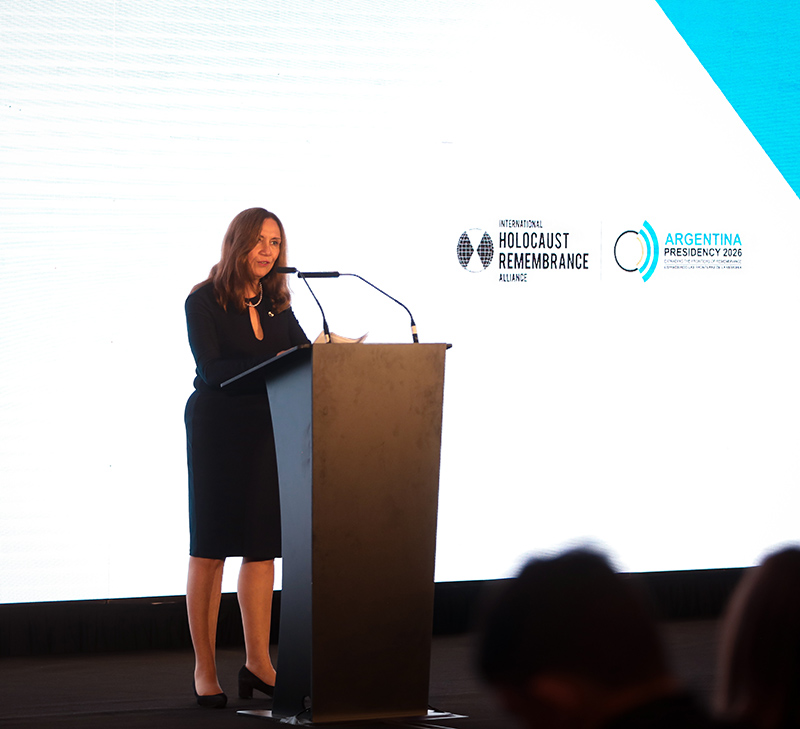
This is why the theme of the Argentine Presidency – Ampliando las fronteras de la memoria – Expanding the Frontiers of Remembrance – is so timely. It reminds us that remembrance must continue to travel: across borders, across languages, and across generations. And it reminds us that Holocaust remembrance is a global responsibility.
Argentina’s connection to Holocaust history reflects both refuge and difficult historical truths. This complexity makes the work of archives and historical research all the more important.
I therefore welcome the initiative of the Argentine presidency, for 'digital preservation and access to archives related to the Holocaust and the second World War,’ which are kept by the Historical Archive of Argentine Foreign Ministry.
Ladies and Gentlemen,
Across many countries, we are seeing renewed debates about how Holocaust history is remembered, interpreted and sometimes politicized. To confront current challenges, the IHRA has initiated a process to formulate a new strategy.
I also appreciate very much, the Israeli presidency initiative towards a seminar for Early-career Holocaust Researchers. The strong response to this seminar initiative – with almost 100 eligible applications received – demonstrates the continued commitment of younger generations to Holocaust research and remembrance.
Supporting this next generation of researchers and practitioners is also part of how the IHRA prepares for the future – through cooperation, shared responsibility, and openness to different experiences and perspectives. That spirit has always defined the IHRA. And it is the spirit in which we begin this plenary week together.
Dear friends,
These stories must continue to be heard. Not only in museums and memorials. But in classrooms. In archives. In research. And in public life.
The frontiers of remembrance are not only geographic. They also exist between generations. Our task is to ensure that these stories continue to cross them.
Thank you.