Dear Minister of Foreign Affairs, Pablo Quirno.
Dear authorities of the national government
Dear members of the diplomatic corps accredited to our country,
Dear Secretary General of the IHRA, Michaela Küchler,
Dear IHRA delegates and honored guests,
Dear leaders of the Jewish community and the local chapter of the IHRA,
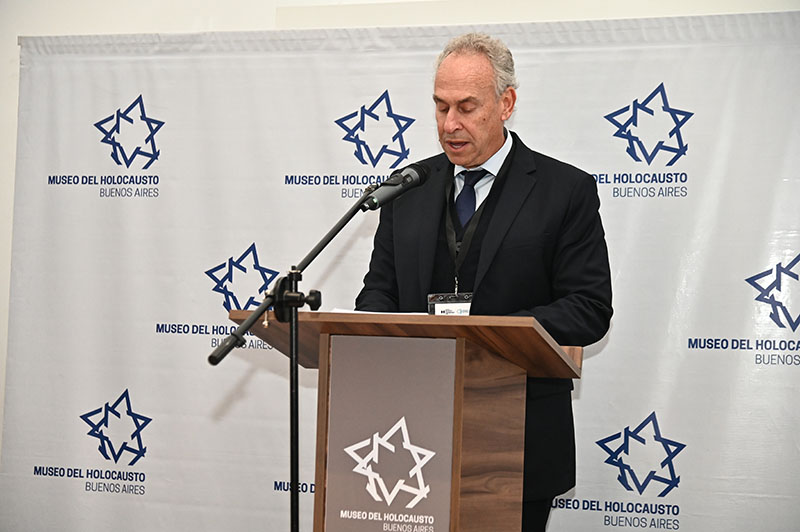
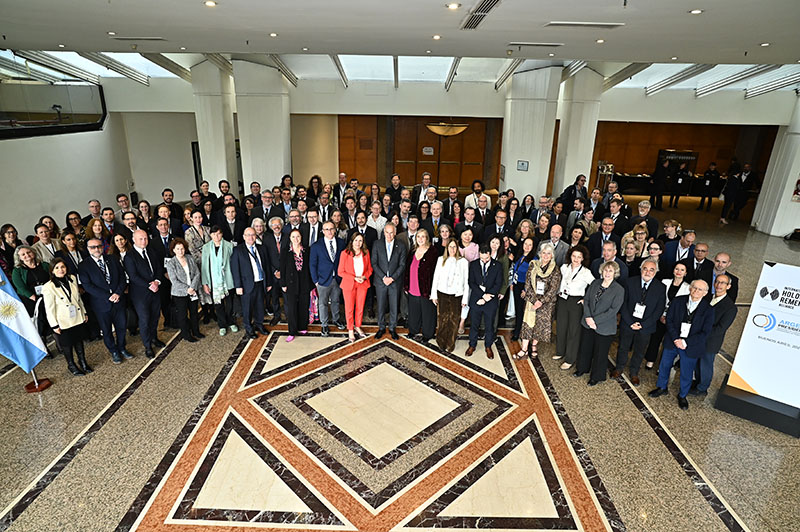
On behalf of the Argentine presidency of the IHRA, I would like to extend our warmest welcome to the other side of the equator, to the Global South, to Latin America, to our country, to Argentina. I especially want to welcome those who have traveled for many hours and from far away.
It is an honor to welcome you today to the City of Buenos Aires and to wish you an excellent stay throughout this significant and intensive program that we have built together.
I would like to highlight the presence of President Javier Milei at this welcome ceremony, which demonstrates both the Argentine State’s historic commitment through more than twenty years of membership in the IHRA, and also the decision of his administration to apply to this presidency and to make this presidency a reality. I want to thank President Milei once again for granting me the big honor of appointing me Chair of this deeply important organization. Likewise, I extend my gratitude to Foreign Minister Pablo Quirno and the entire team at the Ministry of Foreign Affairs for their immense dedication to carrying this presidency forward.
Our motto, Expanding the Borders of Memory, carries multiple meanings. First, as I stated in Jerusalem, it represents bringing the IHRA and its mission closer to the Latin American region, and vice versa. It also provides the Alliance with an opportunity to consider the same topics of discussion and organizational challenges from a different perspective, shaped by both geography and our unique identity and culture.
Being the sole Latin American member of this organization for over twenty years is an exception we hope to move past very soon. We will exert every effort to ensure that the challenges addressed by the IHRA achieve the greatest possible impact and reach within the region.
During your time here, you will witness the growing importance of this exemplary remembrance, driven by survivors, the Jewish community, civil society, and, in recent decades, State policies.
You can explore much of this history in the exhibition "Argentina and the Holocaust" on display here at this hotel, created by a special team at the Holocaust Museum of Buenos Aires—an institution I have the honor to chair.
We speak of Holocaust remembrance in Argentina as a State policy, fully aware that antisemitism has been and remains present in our country—its most devastating expressions being the two terrorist attacks that shook us in the 1990s.
We recognize that there have been lights and shadows throughout our history. Our country is home to the largest Jewish community in the region and the sixth largest in the world, with countless examples of outstanding integration in fields such as art, culture, and science.
Nevertheless, nobody denies argentine responsibility in nazi war criminals coming to the country but we also emphasize that it was a country that received thousands and thousands of Holocaust survivors who rebuilt their lives and families.
I would like to express my gratitude to everyone who has worked with enormous dedication to bring us to this day.
Thank you, Michaela Küchler, for your collaboration alongside the entire Permanent Office to ensure that every aspect of this presidency and this plenary session is handled with the utmost care.
Thank you to my Co-Chair, Ambassador Fabiana Loguzzo, for her excellence and tremendous capacity for hard work, alongside the entire presidency team.
Thank you to all the Working Group and Committee Chairs, who I know have worked with great dedication to make the most of the experience in our country and to achieve the best results within each group.
Thank you to all the delegates for dedicating your time, knowledge, and expertise to a mission as noble as that of this organization.
We hope that the city of Buenos Aires proves inspiring to you, that you can feel its energy, and that you enjoy a comfortable experience for all the vital work you have come here to accomplish. You hope to find together the many opportunities that lie ahead to continue building together, fostering cooperation and understanding.
The most famous book produced by gaucho poetry in our country— Gauchos being those men of the countryside who have deeply shaped the Argentine identity—is called Martín Fierro, written by José Hernández. Its most famous passage speaks to the vital importance of fraternity and says a great deal about what unites us as a nation. I will read in Spanish and then in English:
"Los hermanos sean unidos
Porque esa es la ley primera
Tengan unión verdadera
En cualquier tiempo que sea
Porque si entre ellos se pelean
Los devoran los de afuera."
"Brothers must stand united—
for that is the first law.
They must remain truly united, at all times,
because if they fight among themselves,
they will be devoured by those outside."
Let us follow this Argentine maxim, and let us stand united for an excellent plenary session.
Thank you very much.